
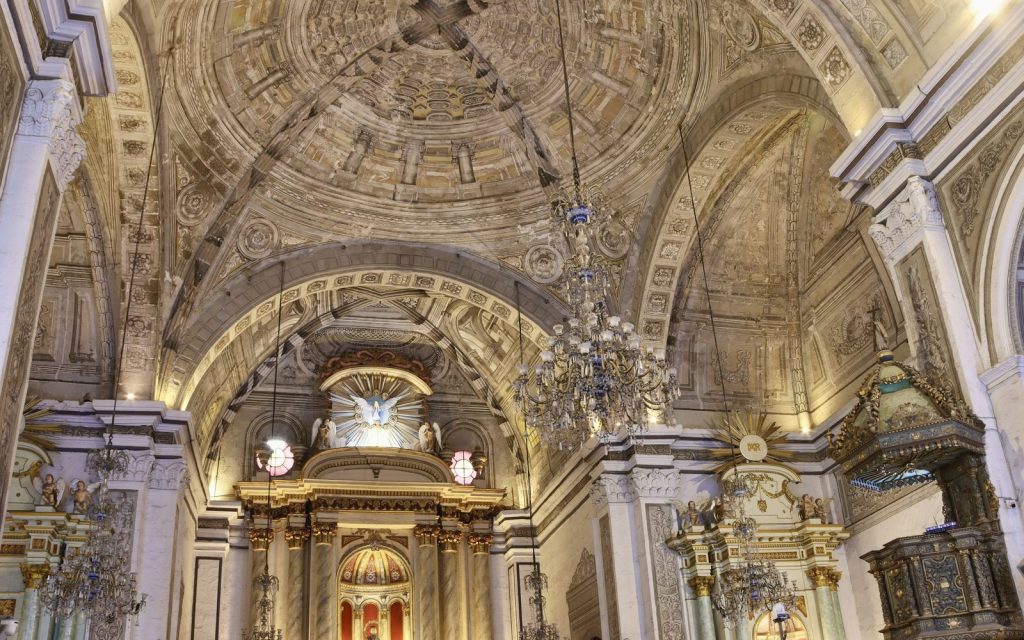
Stand in the nave of San Agustin Church in Intramuros and look up. The ceiling seems to be covered in deep carved panels, rosettes and mouldings. It is almost entirely flat.
The effect is trompe-l’œil, painted in the 1870s by two Italian artists working in Manila. Light, shadow and perspective do the work that stone would have done in a European cathedral, at a fraction of the weight.
Why it matters here
Manila sits on an earthquake belt. A heavy stone vault is a risk; a painted one is not. San Agustin has survived several major earthquakes, and its ceiling is part of the reason.
How it was done
The painters worked on scaffolding for months, using colour and shading to suggest depth: lighter tones on the parts meant to come forward, darker ones on the recesses. Seen from the floor, the eye reads the flat surface as carved.
The church itself dates from the early 1600s and is one of the oldest stone churches in the country. It is part of a UNESCO World Heritage listing for the Baroque churches of the Philippines.
There is a small entrance fee for the museum next door, which is worth the time for its cloister and the view of the nave from the choir loft.
Visiting
Mass is still held in the church, so visit outside service times and dress respectfully. Photography without flash is usually allowed in the nave; ask at the entrance if you are unsure.
The rest of Intramuros is worth the afternoon: the walls, the cobbled streets and the restored houses around Plaza San Luis. Walk the walls at sunset for the view of the old city on one side and the towers of the new one on the other.
Bring water and patience; the streets are narrow and the jeepneys do not slow down for tourists.
Go in the late morning, when the light from the windows is strongest, and walk slowly down the aisle. The panels seem to shift as you move.